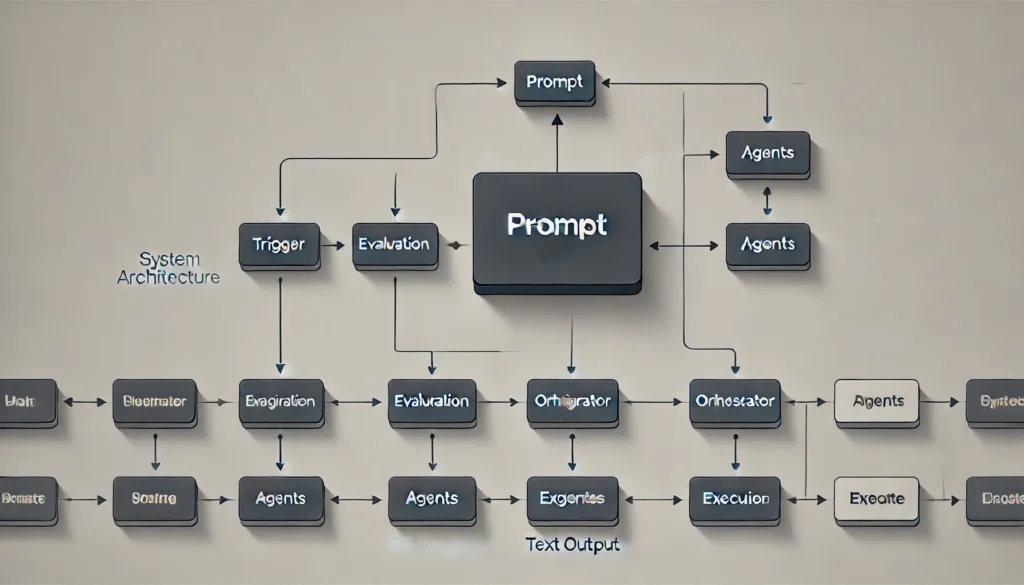
Most AI projects don’t fail because the model is weak.
They fail at the hand-off point.
The moment where an output is supposed to become an action.
That gap — between text generation and system execution — is where most so-called “AI automation” quietly collapses.
If your AI Agent Workflow stops at a response in a chat window, you don’t have a system. You have a demo.
This guide explains how to move from isolated prompts to coordinated, multi-agent systems that actually execute. No fluff. No metaphors. Just architecture.
The Hand-off Problem: Where AI Systems Actually Break
The core issue is not intelligence.
It’s transfer.
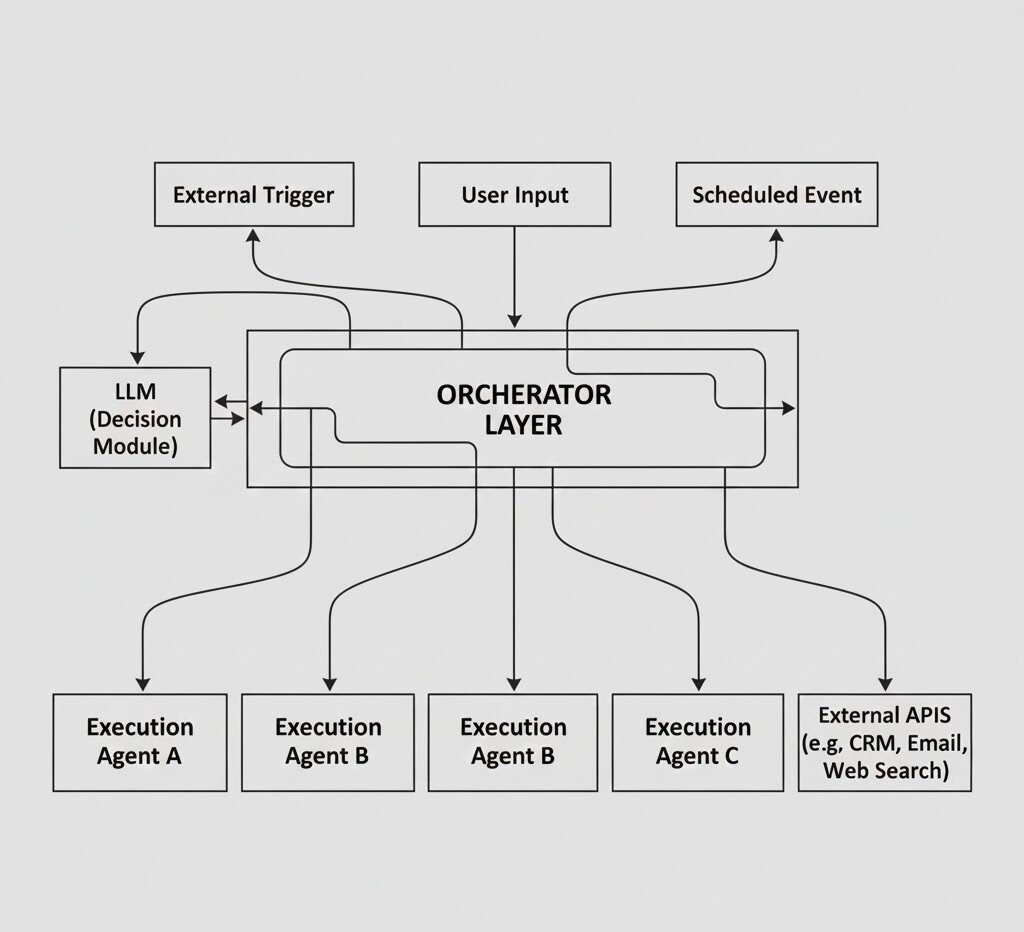
Most teams wire an LLM to a trigger and expect magic. The model generates text. Someone copies it. Another system receives it. Latency spikes. State is lost. Context decays.
This is not automation. This is human middleware.
The hand-off problem appears in three places:
- State Loss: The model has no persistent memory of prior decisions.
- Ambiguous Output: Free-form text cannot be parsed reliably by downstream systems.
- Manual Confirmation Loops: Humans step in because the system cannot commit to action safely.
Every manual step adds latency and introduces failure points. At scale, this becomes operational debt.
If your workflow requires interpretation after the model responds, the system is already broken.
Defining the Central Brain: Orchestrator vs Model
The LLM is not the brain.
It is a reasoning engine.
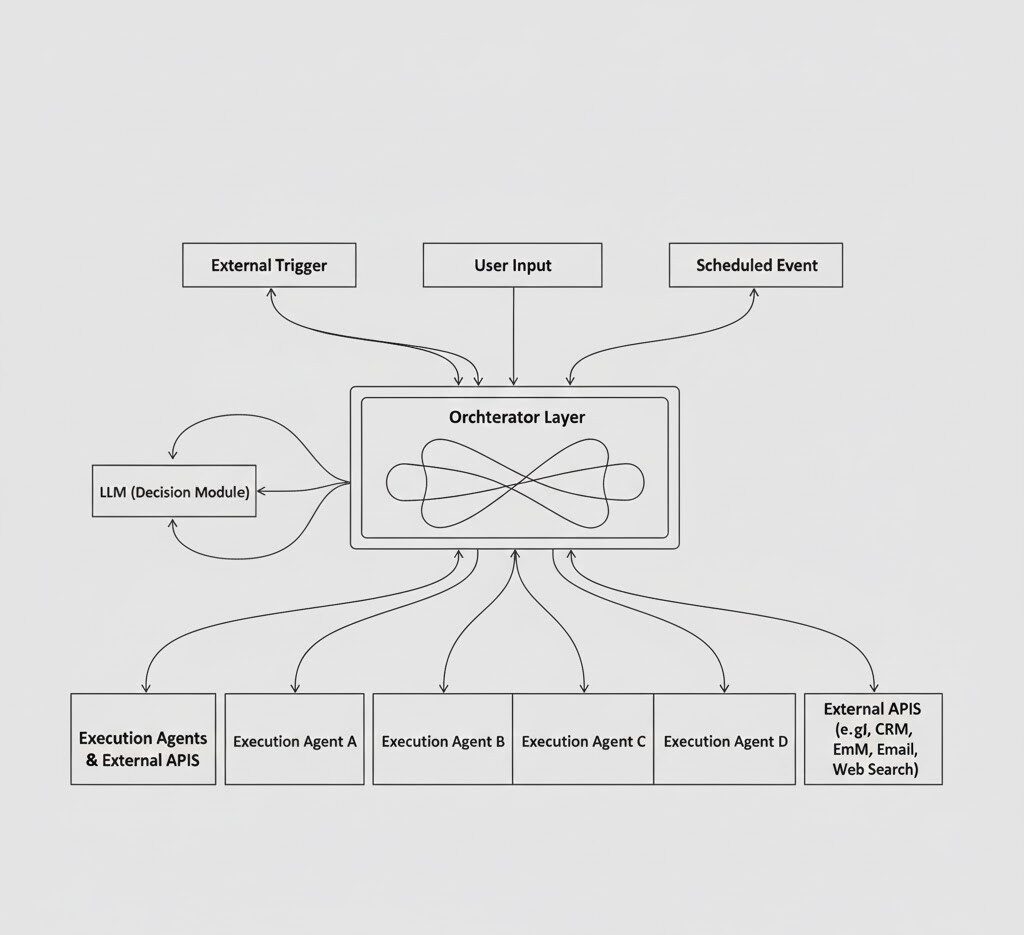
The brain is the orchestrator.
Tools like n8n, LangChain, and Make exist for one reason: stateful control flow. They manage sequencing, retries, branching logic, and API handshakes. The model does none of that reliably on its own.
An LLM decides what should happen.
The orchestrator decides when, where, and with what payload.
Confusing these roles leads to fragile systems.
If you let the model call tools directly without supervision, you create non-deterministic execution. If you hard-code logic and only use the model for copywriting, you waste its reasoning capacity.
The correct pattern is simple:
- Orchestrator owns the workflow.
- LLM owns decision-making within constrained boundaries.
- Agents are specialized executors, not free thinkers.
This separation is non-negotiable in production systems.
The Workflow Blueprint of a Real AI Agent Workflow
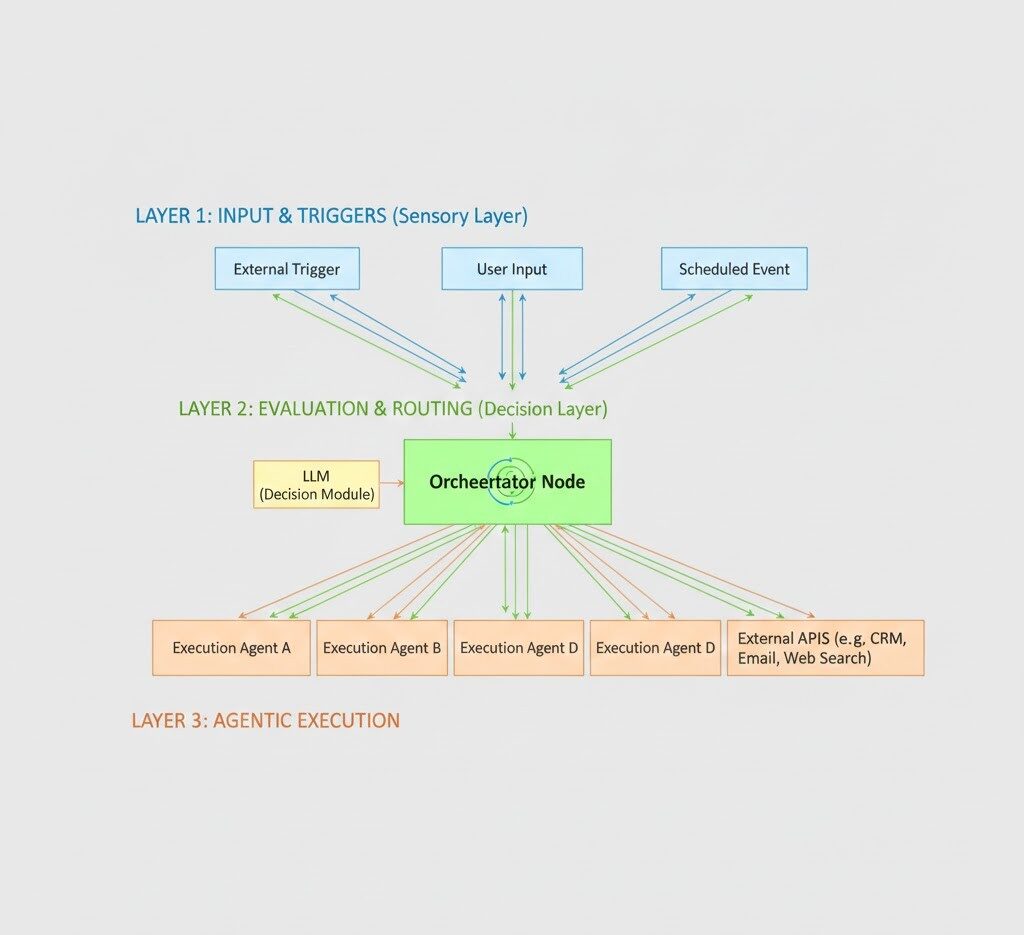
A functioning AI Agent Workflow has layers. Not features. Layers.
Each layer has a single responsibility. If a component tries to do more, it becomes unstable.
Step 1: Input & Trigger — The Sensory Layer
This layer detects change.
User input, webhook events, database updates, sentiment shifts, ticket volume anomalies. It does not interpret. It only signals.
Common mistakes here include over-filtering and premature interpretation. The sensory layer should be noisy. Let downstream logic decide relevance.
Latency matters at this stage. Batch where possible. Stream where required. Never block execution waiting for the model.
Step 2: Evaluation & Routing — The Decision Layer
This is where the LLM earns its cost.
The model evaluates context and returns structured decisions, not prose. Classification, priority scoring, routing flags.
This layer answers one question: What should happen next?
Not how. Not why. Just what.
Routing logic belongs in the orchestrator. The model provides signals. The orchestrator executes branches.
If your model output cannot be consumed by a switch statement, it is not ready for this layer.
Step 3: Agentic Execution — The Muscle Layer
Agents do work.
One agent writes. Another analyzes. Another pushes updates to a CRM. Another opens tickets or updates a roadmap.
Agents do not decide whether they should act. They are invoked with a payload and expected to respond deterministically.
This is where most “multi-agent systems” fail. Teams give agents too much autonomy and no guardrails. The result is unpredictable behavior and broken state chains.
An agent should be disposable. If it fails, the orchestrator retries or swaps it. No agent should hold critical system memory.
Technical Deep Dive: Why JSON Is the Only Language That Matters
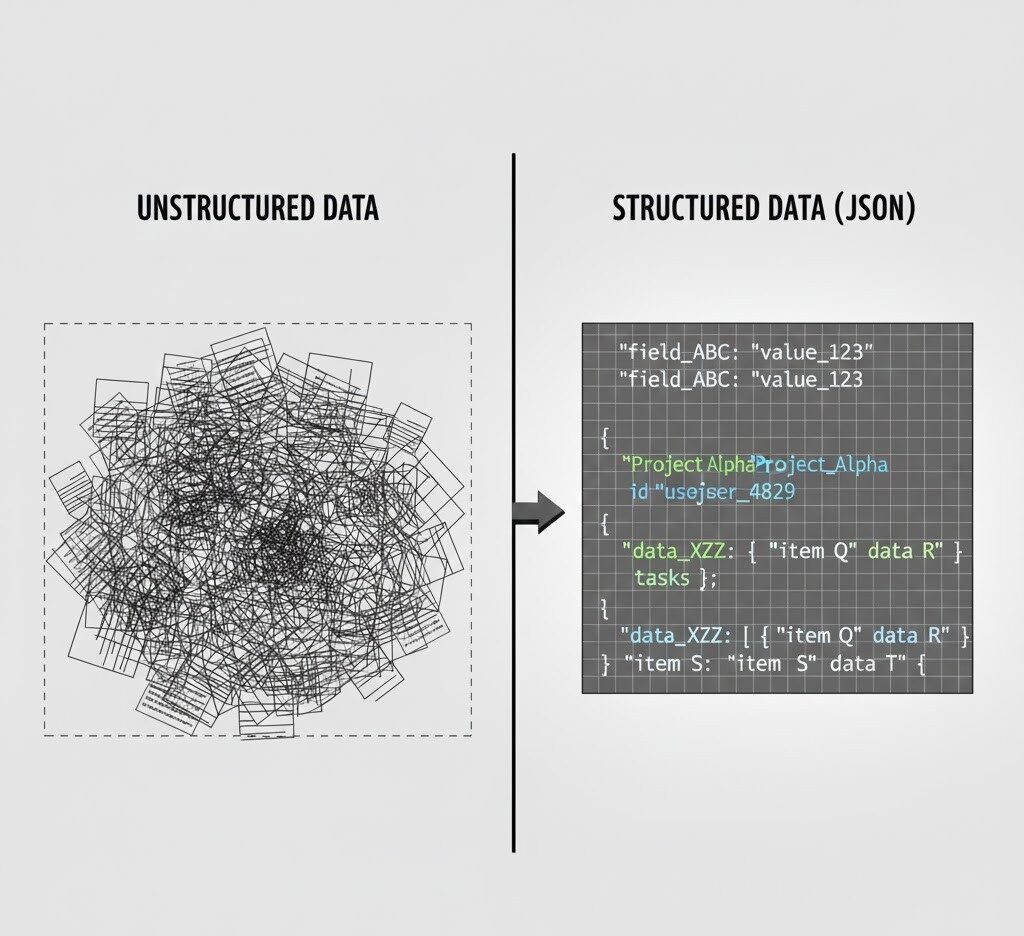
Text is for humans.
JSON is for systems.
Every agent-to-agent interaction must be expressed as machine-readable output. No exceptions.
JSON enforces:
- Schema validation
- Deterministic parsing
- Token optimization
- Explicit state transfer
Free-form text introduces ambiguity. Ambiguity breaks automation.
A model that cannot reliably output structured JSON with fixed keys is not ready for orchestration. This is not a prompt engineering problem. This is a system design constraint.
Define schemas early. Version them. Reject malformed payloads aggressively.
Your orchestrator should treat invalid JSON the same way it treats a failed API call: retry or fail fast.
Real-world Scenario: Customer Sentiment → Product Roadmap
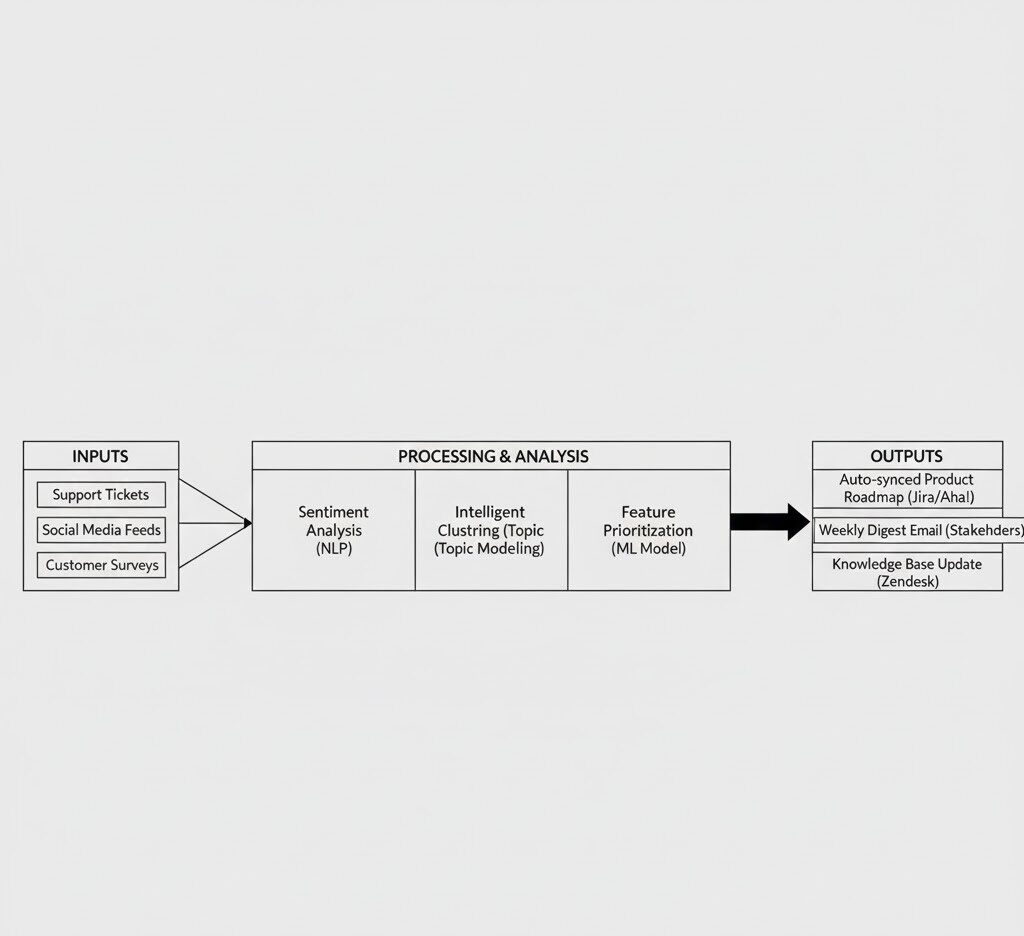
Let’s make this concrete.
A SaaS company collects customer feedback across support tickets, reviews, and social mentions.
Trigger
New feedback enters the system via webhooks and scheduled pulls.
Evaluation
An LLM evaluates sentiment, feature references, and urgency. Output is a JSON object containing sentiment score, feature tags, and confidence.
Routing
The orchestrator routes high-confidence signals to a roadmap agent. Low-confidence signals are aggregated for batch analysis.
Agentic Execution
- One agent clusters feedback by feature.
- Another agent estimates business impact.
- A third agent updates a product backlog in Jira with structured summaries.
No human rewrites anything.
No copy-paste exists.
Humans approve priorities, not text.
This pipeline runs continuously. It compounds value over time. That is an Autonomous Pipeline.
AI Orchestration Is About Control, Not Intelligence
Most teams overestimate model intelligence and underestimate system design.
AI Orchestration is not about chaining prompts. It is about controlling execution under uncertainty.
Retry logic, timeouts, fallback models, versioned prompts, payload validation. These are not optional details. They are the system.
If you cannot pause, inspect, and replay a workflow, you don’t control it.
2026 Outlook: Interfaces Are a Liability
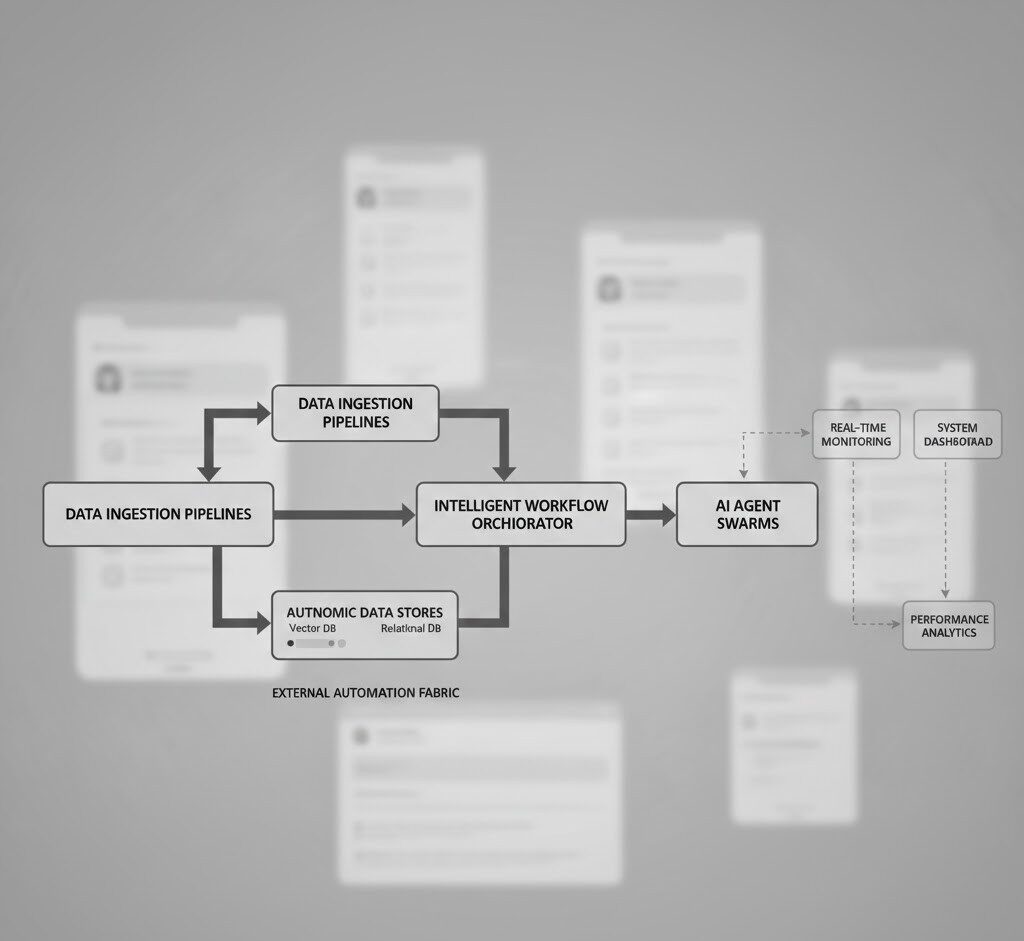
Interfaces slow systems down.
Dashboards, chat windows, and manual approval steps exist to compensate for weak pipelines. As Autonomous Pipelines mature, interfaces become monitoring layers, not interaction points.
The asset is not the UI.
The asset is the pipeline.
Companies that invest in durable AI Agent Workflow infrastructure will outlast those chasing the latest model release. Models change. Pipelines persist.
The Verdict
Stop building AI toys.
Build systems that move data, make decisions, and execute without supervision.
Everything else is noise.
ExpertStack is not about prompts.
It’s about architecture that survives reality.