
Most companies believe their biggest problem is revenue.
They’re wrong.
The real problem is cost structure.
Specifically, the invisible tax created by manual, human-centric workflows that scale linearly while markets scale exponentially.
You don’t feel this tax on day one.
You feel it when growth stalls, margins compress, and EBITDA flatlines despite “working harder.”
This article is not about AI as a trend.
It’s about AI ROI as a survival mechanism.
If your operations still depend on humans acting as glue between tools, systems, and decisions, you are not running a business.
You are running an expensive relay race.
And you are losing.
The Hidden Tax of Manual Work

Human workflows are linear by design.
One person can do one thing at a time.
Two people can do two things.
Five people require coordination, meetings, approvals, and supervision.
That overhead compounds.
Manual processes introduce what finance rarely labels correctly: Operational Drag.
- Every handoff is latency
- Every decision wait is lost opportunity
- Every repeated task is marginal cost that never goes down
This is not a culture problem.
It is not a motivation problem.
It is a structural inefficiency.
Human labor does not scale. It stacks.
And stacked labor destroys margins.
Companies convince themselves this is “normal.”
They call it teamwork.
They call it collaboration.
Finance calls it EBITDA leakage.
Linear Labor vs Exponential Markets
Markets do not wait for your internal bandwidth.
Customer expectations rise every quarter.
Response times shrink.
Personalization becomes baseline.
Accuracy becomes mandatory.
Meanwhile, your operations move at the speed of inboxes, Slack threads, and human memory.
That gap is where competitors eat you alive.
Not because they are smarter.
Not because they are more creative.
Because their marginal cost per action is lower than yours.
This is the real competitive battlefield.
The “Human Middleware” Trap
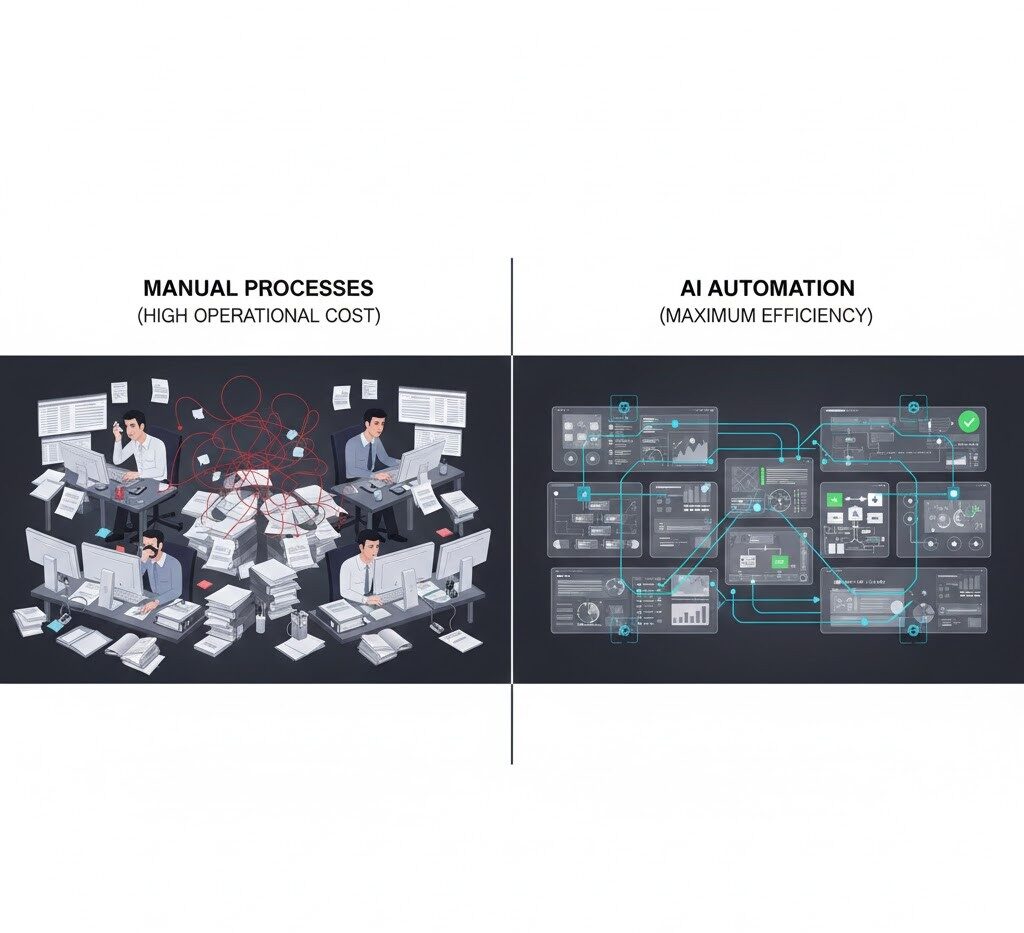
Most modern teams are not doing high-value work.
They are acting as human middleware.
Copying data between systems.
Checking outputs.
Triggering follow-ups.
Formatting reports.
Manually enforcing rules.
This is not strategy.
This is plumbing.
And plumbing is expensive when done by people.
A senior employee spending 30% of their week moving information between tools is not “busy.”
They are misallocated capital.
An AI Orchestrator can execute the same logic, routing, validation, and triggering for fractions of a cent per task.
$0.01 per execution.
No sick days.
No context switching.
No memory decay.
Yet companies keep paying salaries for work that has zero defensibility and zero upside.
That is not conservative management.
That is negligence.
Human Capital Reallocation Is the Real Win
This is where weak thinking collapses.
The question is not “Will AI replace people?”
The real question is:
Why are you paying humans to do work that has no strategic value?
High-quality human capital should be deployed where judgment, negotiation, creativity, and accountability matter.
Everything else is noise.
AI ecosystems are not about headcount reduction.
They are about human capital reallocation.
When orchestration absorbs execution, humans regain leverage.
That leverage shows up in revenue, not payroll.
Buying an AI Tool Is a Cost
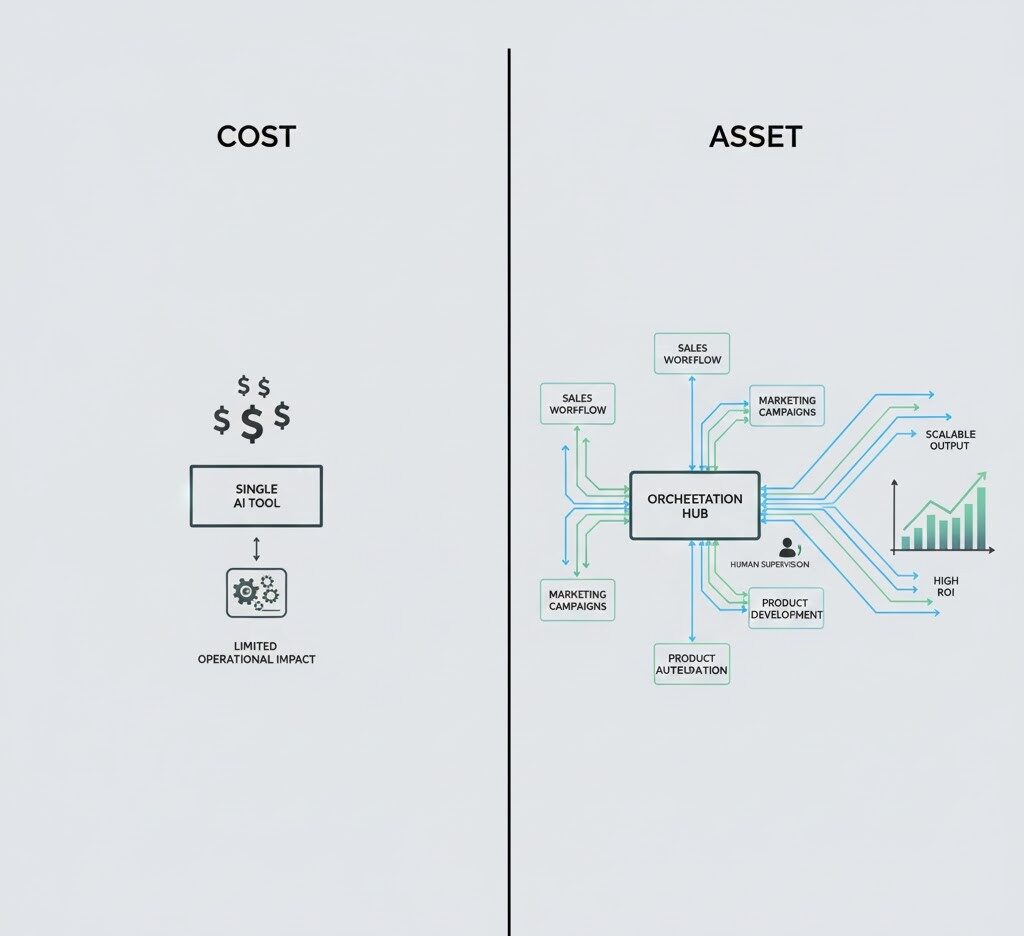
Building an AI Ecosystem Is an Asset
This distinction is where most executives fail.
They buy tools.
They subscribe to dashboards.
They automate isolated tasks.
And nothing changes.
Why?
Because tools without architecture are just faster chaos.
A single AI tool is a cost center.
It depreciates.
It gets replaced.
It creates dependency without compounding returns.
An AI ecosystem is different.
It is structured logic.
Persistent workflows.
Reusable intelligence.
Autonomous pipelines that execute across systems.
That is an asset.
Assets produce return without proportional input.
Costs do not.
Architecture Is Where ROI Lives
AI ROI does not come from prompts.
It comes from system design.
An ecosystem answers questions tools never can:
- What triggers action?
- Who validates output?
- What happens when confidence is low?
- How does data flow across departments?
- Where does escalation occur?
When these decisions are encoded once, they execute forever.
That is how marginal cost collapses.
That is how scalability bottlenecks disappear.
That is how operations turn from drag into acceleration.
The AI ROI Equation (Conceptual, Not Marketing)
Forget vanity metrics.
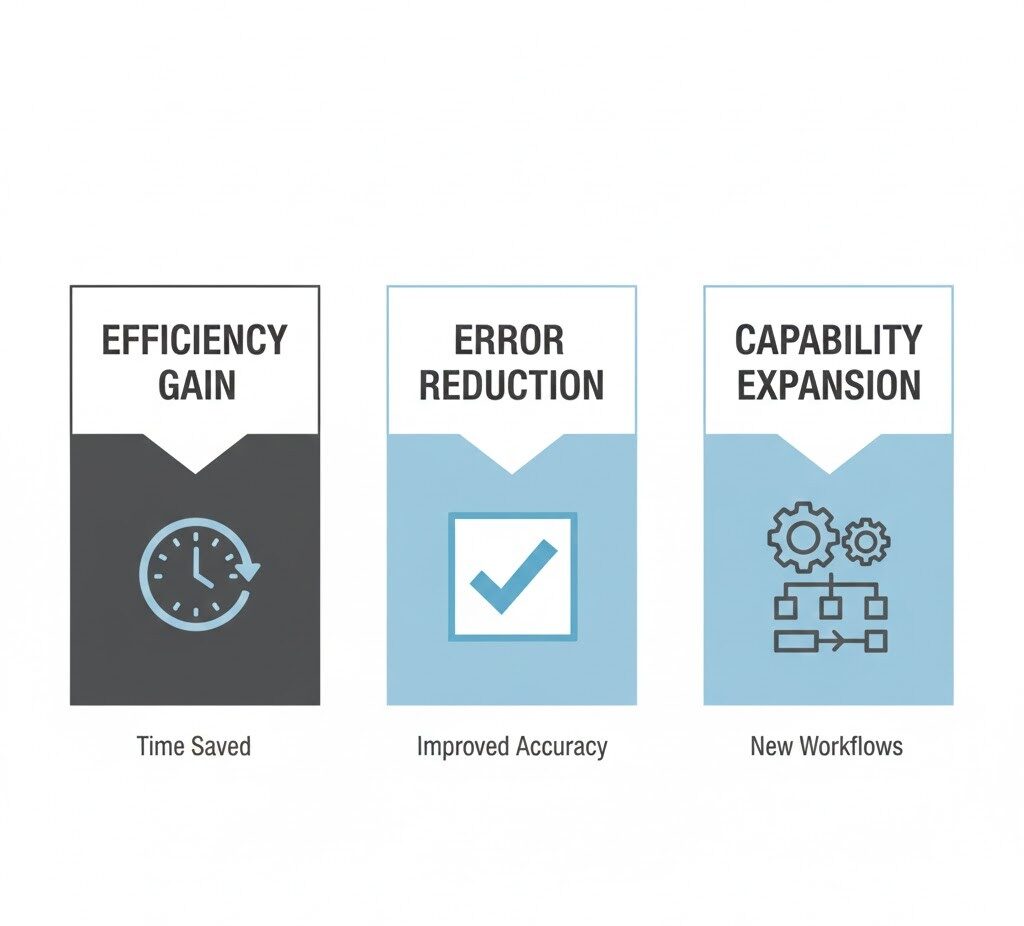
Real ROI shows up in three places:
1. Efficiency Gain
Time reclaimed is not soft benefit.
It is capacity unlocked.
If your team saves 20 hours per week, that is not “nice.”
That is an additional half employee per person per month.
Multiply that across departments.
Now translate it into output, not comfort.
2. Error Reduction
Human error is expensive because it hides.
Rework.
Missed follow-ups.
Inconsistent decisions.
AI systems execute rules consistently.
They do not forget.
They do not improvise.
Reduced error is reduced risk.
Reduced risk is preserved margin.
3. Capability Expansion
This is the most misunderstood lever.
AI ecosystems allow you to do things you could never justify hiring for.
24/7 monitoring.
Real-time personalization.
Cross-platform orchestration.
Instant reporting at scale.
These are not efficiency gains.
They are new revenue enablers.
That is where AI ROI compounds.
Real-World Math (No Fantasy)
Let’s remove abstraction.
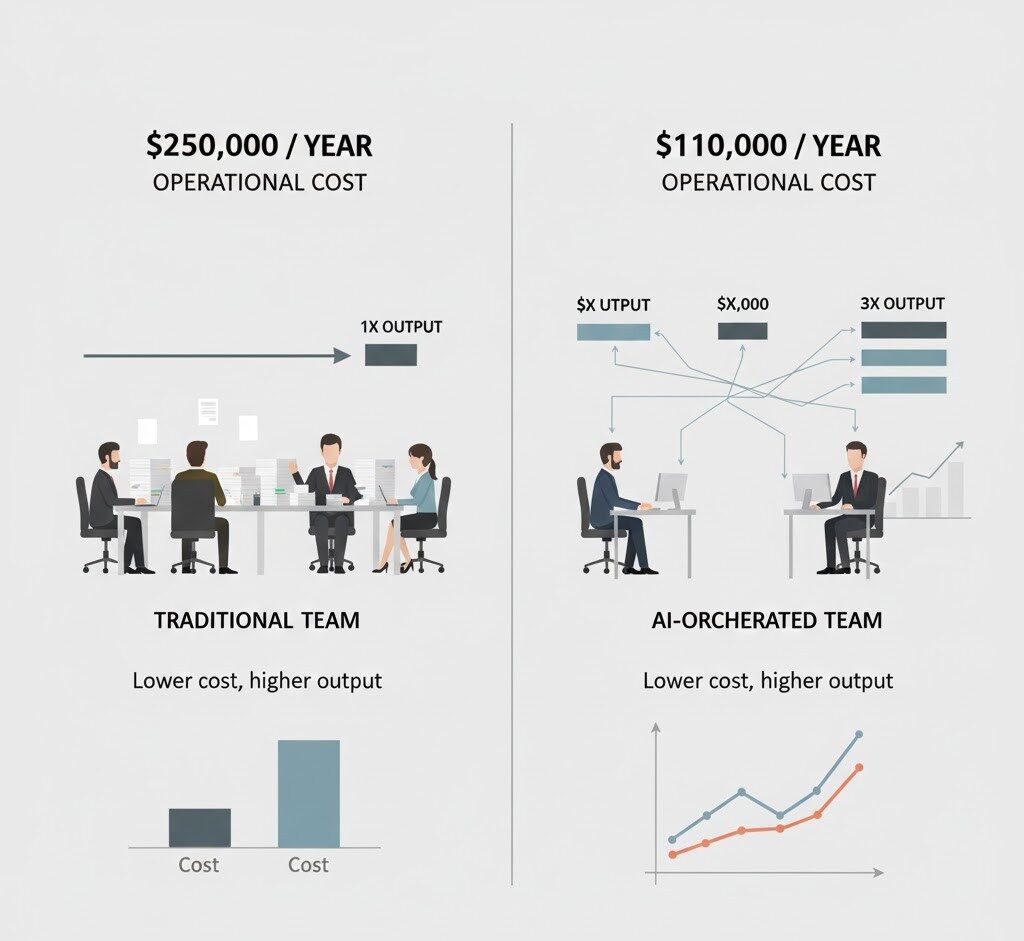
Traditional Team Model
- 5 employees
- 40 hours per week
- Fully loaded cost: ~$250,000 per year
Output is capped by coordination, availability, and fatigue.
Every additional unit of work requires more people.
Marginal cost stays high.
ExpertStack AI Ecosystem Model
- 2 employees
- AI orchestration layer
- Software + infrastructure included
- Total cost: ~$110,000 per year
Output is automated, parallel, and persistent.
Same workflows run 24/7.
Same logic scales across clients, campaigns, or operations.
Result: 3x output with less than half the cost.
This is not efficiency.
This is a structural advantage.
Business Automation Cost vs Business Automation Value
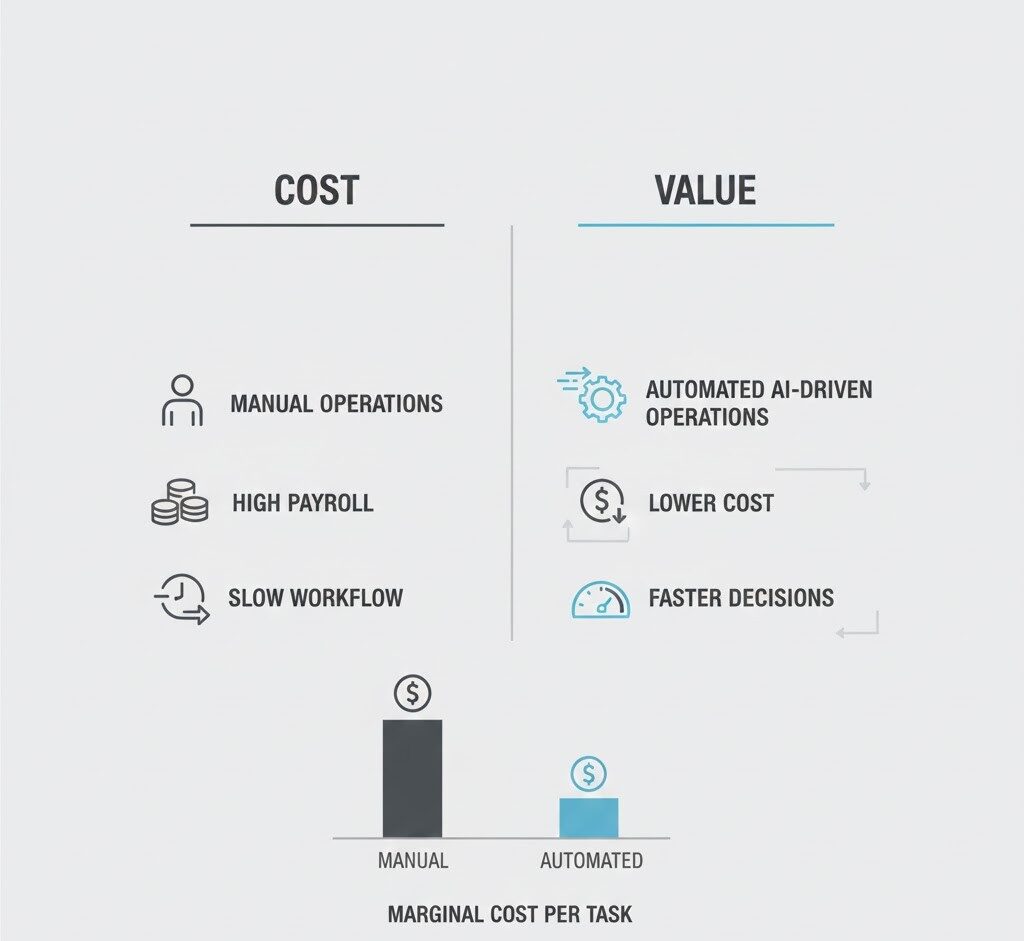
Executives obsess over the cost of automation.
They ignore the cost of not automating.
Manual operations are a silent liability.
They inflate payroll.
They slow response.
They cap growth.
Business automation cost is visible.
Operational inefficiency is hidden.
Markets punish what is hidden first.
AI Investment Strategy is not about chasing innovation.
It is about eliminating fragility.
Why 2026 Will Be Brutal
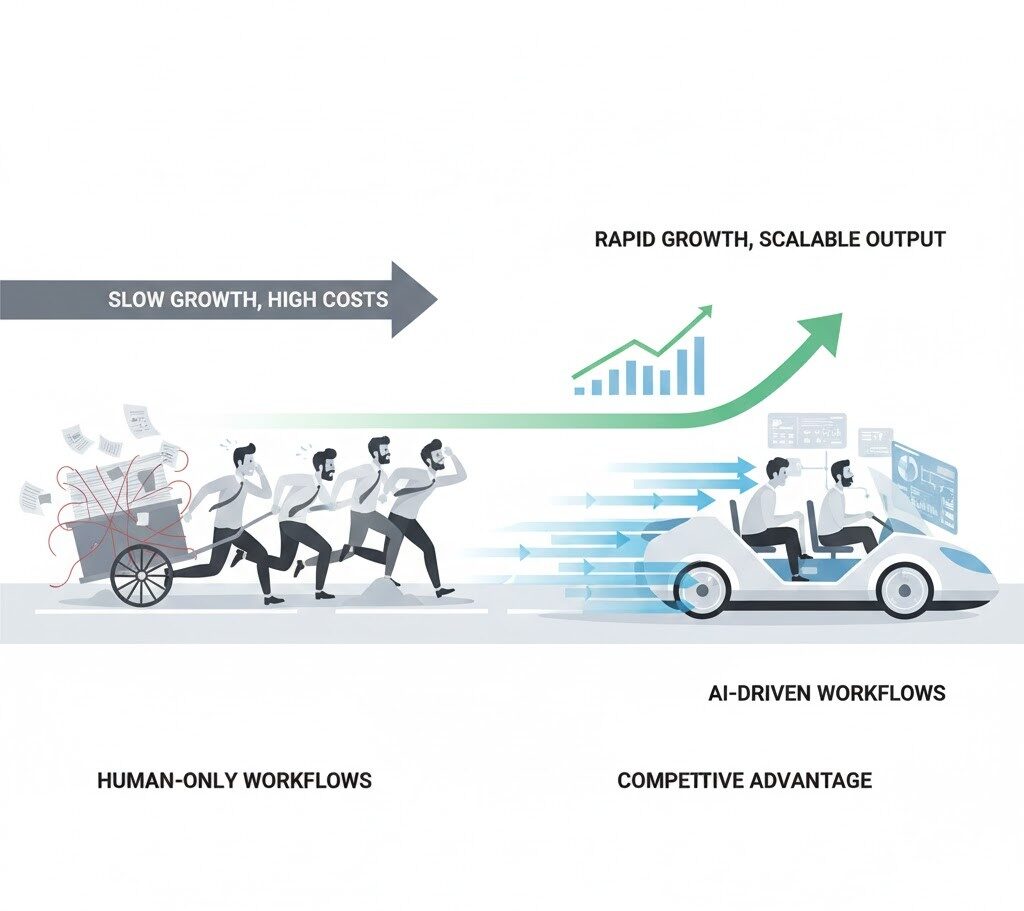
The next competitive wave is not product-driven.
It is architecture-driven.
Companies with autonomous pipelines will:
- Acquire customers faster
- Serve them cheaper
- Iterate without adding headcount
Companies without them will face margin compression they cannot escape.
At that point, acquisition becomes inevitable.
Not because the company failed.
But because its cost structure made independence impossible.
This is how consolidation really happens.
Not through innovation.
Through operational dominance.
ExpertStack Is Not a Tool Vendor
This matters.
ExpertStack does not sell features.
It builds economic systems.
Systems that convert recurring operational expense into compounding assets.
Systems that make human effort multiplicative instead of additive.
Systems that align AI ROI with actual financial statements, not demos.
If your automation does not show up in EBITDA, it is theater.
The Verdict
Manual processes are not tradition.
They are a tax.
Tools without architecture are not strategy.
They are noise.
AI ecosystems are not optional infrastructure.
They are the only rational response to declining margins and rising expectations.
Architecture is not an expense.
It is the only way to survive the margin compression of the next decade.
And the companies that understand this early will not compete.
They will acquire.

